Blog
Tyre Puncture Repair in UAE: Fix It, Replace It, or Go Run-Flat?

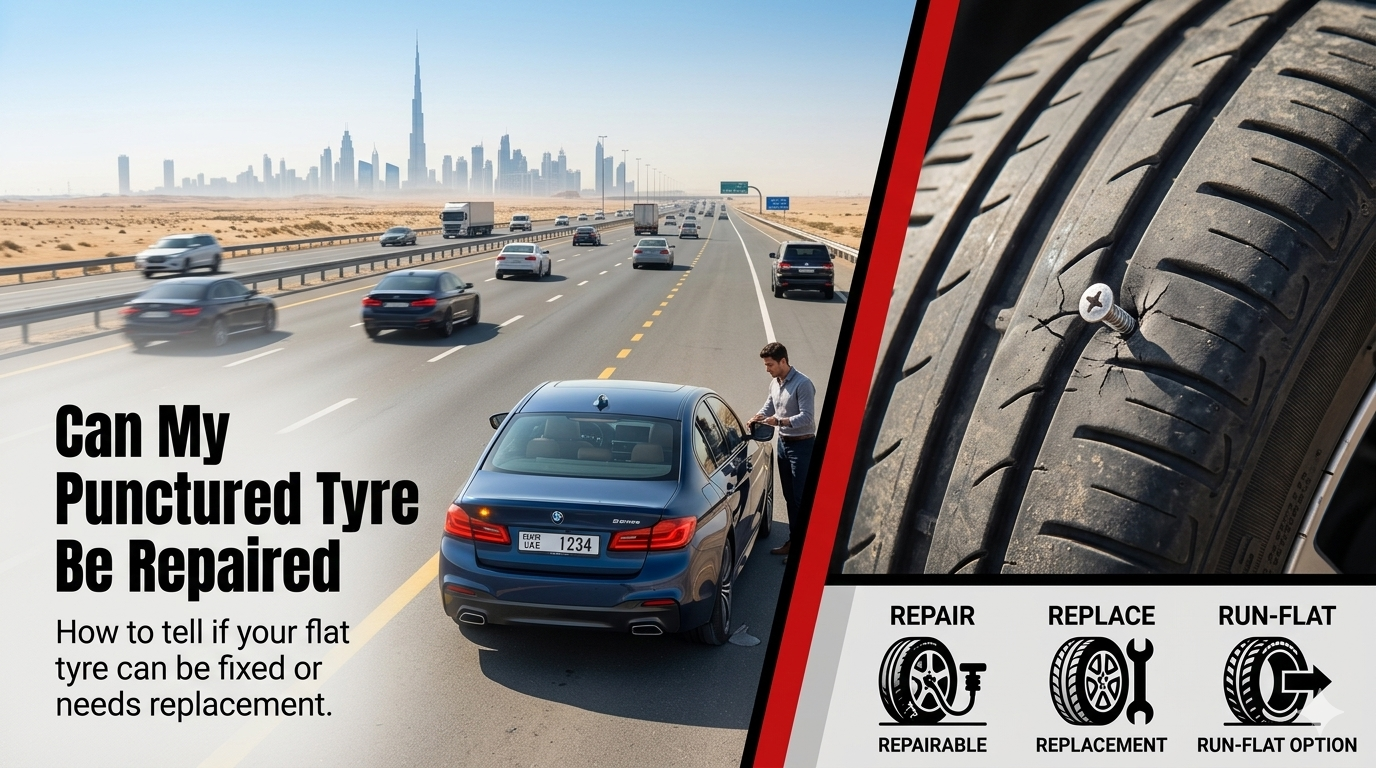
A tyre puncture in the UAE is never just an inconvenience. When it happens at 120 km/h on Emirates Road, on a desert track 40 km from the nearest garage, or on a sweltering Tuesday morning when you’re already late — it becomes a genuine problem. Knowing exactly what to do, what’s repairable, and when you must replace is knowledge every UAE driver needs.
This guide answers the most common puncture questions UAE drivers have: Can this tyre be repaired? Is it safe to drive on? What do run-flat tyres actually do? And how do you prevent punctures in the first place?
💡 Never drive on a completely flat tyre — even for a short distance. Driving flat destroys the tyre, damages the rim, and can cause loss of vehicle control. If you don’t have run-flats, stop safely and call for help.
Can My Punctured Tyre Be Repaired?
Not every puncture means a new tyre — but not every puncture can be safely fixed either. Here are the clear rules:
Repairable Punctures
- Location: tread area only — Punctures in the central tread zone (not shoulders or sidewalls) can be professionally repaired.
- Size: up to 6mm diameter — Anything larger cannot be safely sealed. UAE road debris — screws, nails, sharp stones — often falls within this limit.
- Single puncture — Multiple punctures close together cannot be repaired safely.
- No prior damage — The tyre must not have been driven flat. Even a short distance on a flat tyre causes internal damage that makes repair impossible.
Not Repairable — Replace Immediately
- Sidewall punctures or cuts — The sidewall flexes with every rotation. No repair can withstand this movement safely. UAE law prohibits driving on sidewall-repaired tyres.
- Shoulder area damage — The transition zone between tread and sidewall cannot be safely repaired.
- Punctures over 6mm — Too large for a safe patch or plug repair.
- Tyre driven flat — Internal structural damage from even brief flat driving is often invisible but fatal to long-term safety.
- Multiple punctures — More than one repair in the same tyre reduces structural integrity below safe limits.
- Aged or worn tyres — A tyre at or near the end of its lifeis not worth repairing. Replace with a new tyre.
Tyre Repair Methods: Plug vs Patch vs Plug-Patch
If your puncture is repairable, there are three methods. Not all are equal — especially for UAE conditions:
String Plug (Roadside Repair)
The quick roadside fix — a rubber string is inserted into the puncture from the outside without removing the tyre. Fast and cheap (AED 20–40) but this is a temporary measure only. UAE summer heat causes string plugs to degrade faster than in cooler climates. Suitable for getting to a proper tyre shop — not as a permanent fix.
Internal Patch
The tyre is removed from the rim and a patch is applied to the inside. Stronger than a plug but still not the best option for UAE high-speed driving. Some UAE workshops offer this as a complete repair — it’s adequate for lower-speed use.
Combination Plug-Patch (Recommended for UAE)
The gold standard for puncture repair. The tyre is removed, the puncture is filled with a plug from inside, and a reinforced patch is bonded over it. This is the only repair method recommended for UAE highway speeds. A proper plug-patch repair from a reputable UAE tyre shop typically costs AED 40–80 and will last the remaining life of the tyre if done correctly.
💡 At Abrar Tyres we only perform combination plug-patch repairs on tyres destined for UAE highway use. We will not fit a string plug and send you back onto Sheikh Zayed Road — it’s not safe enough.
Run-Flat Tyres in UAE: Are They Worth It?
Run-flat tyres have reinforced sidewalls that support the vehicle’s weight even after a complete loss of air pressure. This allows you to continue driving at reduced speed (typically max 80 km/h) for up to 80 km after a puncture — giving you time to reach a safe location or tyre shop.
Advantages of Run-Flats for UAE Drivers
- Safety on remote highways — UAE’s long, isolated desert highways leave you vulnerable after a puncture. Run-flats let you reach safety without stopping on a hard shoulder.
- No spare tyre needed — Many newer UAE vehicles with run-flats don’t carry a spare. This frees up boot space and reduces vehicle weight.
- No roadside tyre change — Changing a tyre at the roadside on a UAE motorway at 40°C is dangerous. Run-flats eliminate this entirely.
- Continued vehicle control — A sudden blowout in a standard tyre can cause loss of control. Run-flat reinforced sidewalls prevent catastrophic deflation.
Disadvantages of Run-Flats for UAE
- Higher cost — Run-flat tyres cost 30–60% more than equivalent standard tyres. A set of four for a UAE sedan typically costs AED 2,500–4,500.
- Harsher ride — The reinforced sidewalls transmit more road vibration — noticeable on UAE’s occasional rough road surfaces.
- Cannot be repaired after running flat — A run-flat that has been driven on after puncture must be replaced, not repaired. This eliminates the cost benefit of repair.
- Limited UAE availability — Not all sizes are readily stocked. Plan ahead when replacing.
What to Do When You Get a Puncture in UAE
Step-by-step guide for UAE drivers:
- Step 1 — Don’t panic, don’t brake hard. Grip the steering wheel firmly, ease off the accelerator gradually, and steer to the hard shoulder or a safe area away from traffic.
- Step 2 — Switch on hazard lights immediately. As soon as you feel the puncture, activate your hazard lights before you’ve even stopped.
- Step 3 — Stop completely before inspecting. Never inspect a tyre while the vehicle is moving, even slowly.
- Step 4 — Place warning triangles. UAE law requires warning triangles behind your vehicle. Place them 50–100 metres back on highways.
- Step 5 — Call for help if you don’t have a spare. Do not attempt to drive on a flat standard tyre. Call a roadside assistance service or tyre shop.
- Step 6 — If you have a spare, change it safely. Ensure the car is on stable, level ground away from traffic before attempting a tyre change.
- Step 7 — Visit a tyre shop as soon as possible. Even if you’ve fitted a spare, have the punctured tyre inspected and either repaired or replaced immediately.
How to Prevent Tyre Punctures in UAE
UAE roads have specific puncture risks that drivers in other countries rarely face. Here’s how to reduce your risk significantly:
- Maintain correct tyre pressure — Under-inflated tyres are far more vulnerable to puncture from UAE road debris. Check pressure every two weeks.
- Inspect tyres regularly — Look for embedded nails, screws, or glass before they cause a full puncture. Many UAE punctures begin as slow leaks.
- Avoid construction zone roads — UAE’s constant construction generates enormous quantities of sharp metal debris on surrounding roads. Slow down and avoid where possible.
- Don’t overload your vehicle — Overloaded tyres have less sidewall height and are more vulnerable to damage from UAE road imperfections.
- Choose quality tyres — Premium and mid-range tyre compoundsare significantly more puncture-resistant than budget alternatives — especially relevant in UAE construction zones.
Frequently Asked Questions
Can a tyre puncture be repaired in UAE?
Yes — punctures in the central tread area up to 6mm diameter can be safely repaired using a combination plug-patch method. Sidewall punctures, shoulder damage, or any tyre driven flat cannot be repaired and must be replaced. At Abrar Tyres, we assess every puncture honestly before recommending repair or replacement.
How much does tyre puncture repair cost in UAE?
A professional combination plug-patch repair at a reputable UAE tyre shop costs AED 40–80. Roadside string plug repairs are cheaper (AED 20–40) but are temporary fixes only — not suitable for UAE highway speeds. Replacement tyres range from AED 150 (budget) to AED 1,500+ (premium) depending on size and brand.
Are run-flat tyres available in UAE?
Contact us for availability and pricing
Can I drive on a flat tyre to reach a garage in UAE?
Only if you have run-flat tyres — which are designed for exactly this situation (max 80 km/h for up to 80 km). On standard tyres, driving flat even 1–2 km causes severe internal tyre damage, destroys the rim, and can cause sudden loss of control. Stop safely and call for assistance instead.
How long does a tyre repair take at Abrar Tyres?
Final Word: Repair Smart, Replace When Needed
A tyre puncture in the UAE doesn’t always mean a new tyre — but it always means getting it assessed by a professional immediately. Driving on a compromised tyre at UAE highway speeds is one of the most dangerous things you can do on UAE roads.
FAQ 1: Can a tyre puncture be repaired in UAE?
Yes — punctures in the central tread area up to 6mm diameter can be safely repaired using a combination plug-patch method.
Sidewall punctures, shoulder damage, or any tyre driven flat cannot be repaired and must be replaced.
At Abrar Tyres, we assess every puncture honestly before recommending repair or replacement — we will never charge you for a new tyre if a repair is safe and sufficient.
FAQ 2: How much does tyre puncture repair cost in UAE?
A professional combination plug-patch repair at a reputable UAE tyre shop costs AED 40–80.
Roadside string plug repairs are cheaper at AED 20–40 but are temporary fixes only — not safe for UAE highway speeds.
Replacement tyres range from AED 150 for budget options up to AED 1,500+ for premium brands, depending on size and brand.
At Abrar Tyres, fitting is always free with every tyre purchase — no hidden charges.
FAQ 3: Are run-flat tyres available in UAE?
Yes — Abrar Tyres stocks run-flat tyres from major brands for a wide range of UAE vehicles.
Run-flat tyres are particularly popular with UAE drivers who regularly use remote highways or travel long distances between emirates.
They allow you to continue driving at up to 80 km/h for up to 80 km after a puncture — giving you time to reach a safe location or tyre shop without stopping on a dangerous hard shoulder.
Contact us on +971 6 748 1610 or visit our Ajman and Musaffah branches for availability and pricing for your specific vehicle size.
FAQ 4: Can I drive on a flat tyre to reach a garage in UAE?
Only if your vehicle is fitted with run-flat tyres — which are specifically designed for this situation and allow driving at a maximum of 80 km/h for up to 80 km after a puncture.
On standard tyres, driving flat even 1–2 km causes severe internal structural damage to the tyre, destroys the rim, and can cause sudden loss of vehicle control — particularly dangerous on UAE motorways.
If you have standard tyres and get a puncture, stop safely away from traffic, switch on your hazard lights, place warning triangles, and call for roadside assistance or contact Abrar Tyres on +971 6 748 1610.
FAQ 5: How long does a tyre repair take at Abrar Tyres?
A professional plug-patch puncture repair at Abrar Tyres typically takes 20–30 minutes from the time your vehicle is on the ramp.
If inspection reveals that the tyre cannot be repaired and a replacement is needed, most standard sizes are in stock for same-day fitting — usually completed within 30–45 minutes.
Walk-ins are always welcome at both our Ajman and Musaffah branches — no appointment needed, no waiting days.
Just drive in and we will get you back on the road as quickly as possible.