Blog
How to Check Your Tyre Expiry Date in UAE And When to Replace

Most UAE drivers change tyres when they look visibly worn — cracked sidewalls, flat tread, or a slow puncture that keeps coming back. But by that point, the tyre has often been unsafe for months. In the UAE’s extreme heat, rubber degrades from the inside out. A tyre can look perfectly normal on the outside while being structurally compromised internally — and the only way to know for certain how old your tyres are is to read the manufacture date stamped on the sidewall.
This guide shows you exactly where to find the date, how to read it, and what the numbers mean for your safety on UAE roads.
💡 UAE heat accelerates tyre ageing by 40–60% compared to cooler climates. A 4-year-old tyre in the UAE is equivalent to a 6–7 year old tyre in Europe in terms of rubber degradation.
Where Is the Tyre Expiry Date?
There is no “expiry date” stamped on a tyre in the traditional sense. Instead, every tyre in the world is required to display a DOT code (Department of Transportation code) on the sidewall — and the last four digits of this code tell you exactly when the tyre was manufactured.
Look on the sidewall of your tyre for a series of characters beginning with the letters DOT. It will look something like this:
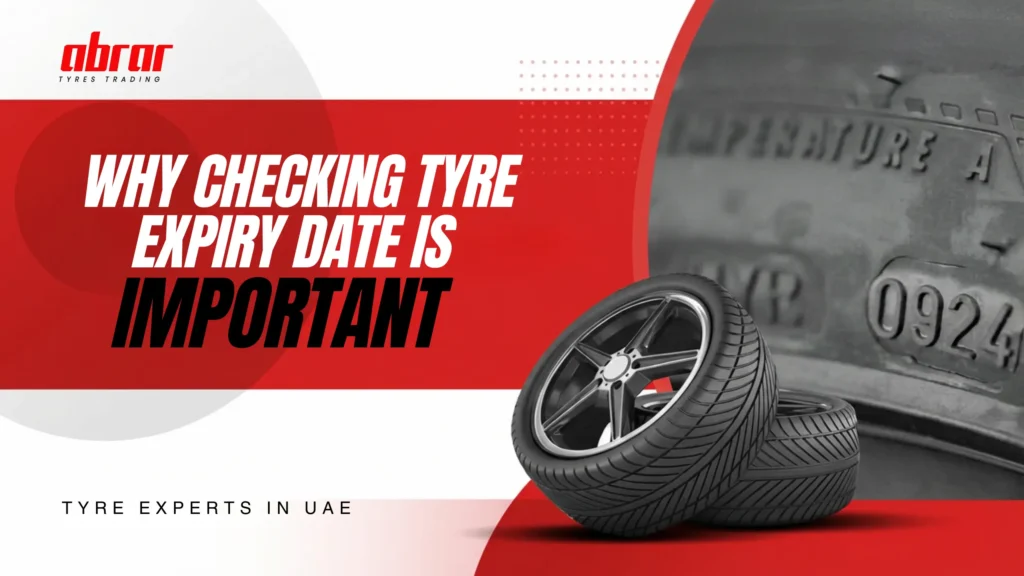
DOT U2LL LMLR 1223
💡 The last four digits are what matter: the first two digits = the week of manufacture, the last two = the year. So “1223” means the 12th week of 2023 — manufactured in March 2023.
How to Read the DOT Code — Step by Step
- Step 1 — Crouch down beside your car and look at the outer sidewall of your tyre. The text can be small — use your phone torch if needed.
- Step 2 — Look for the letters “DOT” followed by a series of numbers and letters.
- Step 3 — Find the last four digits in the sequence. These are always the final four characters before any additional markings.
- Step 4 — Read the first two digits as the week number (01 to 52). Read the last two digits as the year.
- Step 5 — Calculate the age: subtract the manufacture year from the current year. If the result is 4 or more, have the tyre professionally inspected immediately.
Example: DOT code ending in 2821 means week 28 of 2021 — manufactured in July 2021. In May 2026, this tyre is approaching 5 years old and should be inspected or replaced.
When Should You Replace Tyres in UAE?
The 3–4 Year Rule for UAE Conditions
Global tyre manufacturers recommend replacing tyres at 6 years as a general guideline — but this applies to temperate climates. In the UAE, where road surface temperatures exceed 70°C in summer and UV radiation is among the highest in the world, most tyre specialists recommend a 3–4 year replacement cycle, regardless of remaining tread depth.
- 3 years — Have the tyres professionally inspected. In high-mileage or heavy vehicles, consider replacing at this point.
- 4 years — Replace regardless of how the tyre looks. UAE heat has degraded the internal rubber compound beyond safe use in most cases.
- 5+ years — Replace immediately. Do not drive another week on tyres this old in UAE conditions.
Signs to Look For Regardless of Age
- Cracks on the sidewall — Even small surface cracks indicate advanced rubber oxidation. Do not wait.
- Tread depth below 2mm — Legal minimum in UAE is 1.6mm. Replace at 2mm for UAE wet-road safety.
- Bulges or bubbles on the sidewall — Internal structural failure. Replace immediately — this tyre can blow out at any moment.
- Vibration or pulling — Can indicate internal tyre damage before any visible sign appears.
- Flat spots after parked long-term — Tyres parked for months in UAE heat develop permanent deformation in some cases.
✅ Free tyre inspection at Abrar Tyres — walk in to either branch and our team will check your DOT dates, tread depth, and sidewall condition at no charge.
Find your nearest branch: abrartyres.com/branches/
Why UAE Heat Ages Tyres So Fast
Rubber is a polymer — a long chain of molecules that stays flexible due to plasticisers embedded in the compound during manufacturing. Over time, these plasticisers evaporate and the rubber becomes brittle. In UAE conditions, this process happens dramatically faster than in cooler climates for three reasons:
- High ambient temperature — Even at night, UAE temperatures rarely drop below 25–30°C in summer. The rubber never fully cools, and the continuous heat drives plasticiser evaporation continuously.
- UV radiation — UAE sunlight intensity accelerates oxidation of the rubber surface. This is why sidewall cracking appears relatively quickly — even on newer tyres left in full sun.
- Road surface temperature — When a tyre rolls across a 70°C road surface for hours at motorway speed, the mechanical heat generated inside the tyre adds to the ambient temperature, accelerating internal compound breakdown.
💡 Even a tyre stored in a cool, dark location will degrade in UAE ambient conditions. Storing a spare in your boot in UAE summer adds years of equivalent ageing to every month it sits there.
Read also: Why Tyres Burst in UAE Summer and How to Prevent It
Buying Second-Hand or Discounted Tyres — Check the DOT First
The UAE market has a significant volume of discounted tyres — whether sold as “old stock”, imported from international markets, or purchased second-hand. Before buying any discounted tyre, always read the DOT code:
- Tyres older than 2 years from manufacture — Be cautious. Negotiate a larger discount and plan to replace sooner.
- Tyres older than 3 years — Not recommended for UAE conditions regardless of price or appearance.
- Tyres older than 4 years — Avoid entirely. No discount justifies the safety risk in UAE heat.
- Unknown or missing DOT code — Do not purchase. The code is mandatory on legal tyres — a missing code suggests counterfeit or damaged stock.
Frequently Asked Questions
What is the legal tyre age limit in UAE?
UAE law requires tyres to meet minimum tread depth (1.6mm) but does not specify a legal maximum age in years. However, RTA and traffic police inspections look for visible deterioration. For safety purposes, tyre specialists universally recommend a 3–4 year maximum in UAE conditions.
Can a tyre look fine but still be unsafe?
Yes — this is one of the most dangerous aspects of tyre ageing in UAE heat. Internal structural damage, compound hardening, and belt separation can occur without any visible external sign. This is why DOT date checking is critical — you cannot assess internal condition by visual inspection alone.
Where can I get a free tyre age check in UAE?
Abrar Tyres in Ajman and Musaffah offers free tyre inspections including DOT date checks, tread depth measurement, and sidewall inspection. Walk in to either branch — no appointment needed. Call +971 6 748 1610 for directions.
Does tyre expiry date affect insurance in UAE?
Insurance policies generally exclude damage caused by mechanical failure of worn or aged components. In the event of an accident caused by a tyre blowout on a 5-year-old tyre, the insurer may investigate whether reasonable maintenance was performed. Driving on aged tyres creates liability risk beyond the direct safety concern.
Get Your Tyres Checked Today
Walk in to Abrar Tyres in Ajman or Musaffah for a free tyre inspection. Our team will check the DOT date on every tyre, measure tread depth, and inspect sidewalls — and give you an honest assessment of whether your tyres are safe to keep or need replacing. No hard sell. Just expert advice from a team that has been fitting UAE tyres for 22 years.
Book or walk in: abrartyres.com/contact-us/
Free Tyre Inspection — No Appointment | +971 6 748 1610 | Ajman & Musaffah
Related Posts
How to Check Tyre Expiry Date & Know When to Change Tyres
-
Posted by
 Abrar Tyres Team
Choosing the Right Tyres for UAE Roads and Terrains
-
Posted by
Abrar Tyres Team
Industrial, Earth Mover & Forklift Tyres in the UAE: An Overview
-
Posted by
Abrar Tyres Team

Best Agricultural Tyres for Tractors and Farm Equipment in the UAE
-
Posted by
Abrar Tyres Team